2025 Total Landscaping—the Museum of Modern and Contemporary Art
Sri Lanka:
Exhibition Review, Art Asia Pacific
2024 Fei Gao—The Red Bean:
Artist Interview, Barbara Journal
2024 Naomi McKenzie—Where We Meet:
Exhibition Essay, Onespace Gallery
2023 Simon Cuthbert—Alma mater:
Exhibition Essay, POP Gallery
2023 Ileigh Hellier—Paintings from Tasmania and the moon:
Exhibition Essay, Backwoods Gallery
2022 Nicola Scott—Impossible Depth:
Exhibition Essay, Onespace Gallery
2021 James Hornsby—High Vis Fumes:
Exhibition Essay, Onespace Gallery
2019 James Hornsby—Don’t Get Your Hopes Up:
Exhibition Essay, Third Quarter Gallery




Exhibition Review
Total Landscaping | The Museum of Modern and Contemporary Art, Sri Lanka
Art Asia Pacific
2025
Sri Lanka’s first modern art museum examines the relationship between land and conflict, showing us the promise of arts-led reconciliation.
It’s hot in Colombo and the air is weighed down by a ripening monsoon. The Crescat Boulevard Shopping Centre is one of the few places in town offering respite from the equatorial endurance test outside. Situated between the Indian Ocean and the Beira Lake, this commercial complex is also home to the Museum of Modern and Contemporary Art Sri Lanka (MMCA). Now in its sixth year of operation, the MMCA is the first of its kind here; a free, publicly accessible modern and contemporary art institution solely dedicated to Sri Lankan visual culture from the 20th and 21st century. Recently, the museum completed a major 8-month-long exhibition titled “Total Landscaping,” skilfully produced by senior curator Sandev Handy and assistant curator Thinal Sajeewa. Featuring 29 interdisciplinary artists connected to Sri Lanka and three distinct show rotations, this ambitious cultural offering examined the contentious role that land disputes have played in shaping Sri Lanka's recent history.
Visitors entering the gallery were greeted by a thriving, temporary “paddy field.” This living, durational piece by Negombo-based multidisciplinary artist Danushka Marasinghe, titled Walk(er) (2016), demarcated the threshold between commercial space and cultural sandbox, and was the only artwork installed for the entire exhibition period. The paddy immersed audiences in a pungent, grassy aroma as it matured, offering a stark reminder of the intense weather conditions awaiting audiences outside. The space was filled with field-recorded cricket song intermittently punctuated by a troubling, nameless noise—inviting a tightening of the throat, a dryness in the mouth. First exhibited in 2016 at the Colombo Art Biennale, this work emerged during a rare window of calm in Sri Lanka’s recent history; a time when the civil conflict was almost a decade in the past, and just before Covid-19 and economic collapse plunged the country back into collective hardship. Marasinghe’s installation evokes the dis-ease germinating in the soil, awaiting its break through the undergrowth—a visceral example of the sensitivity that we so often rely on artists for, and the deep listening that it encourages.
To the left of Marasinghe’s paddy, in a discreet alcove behind a makeshift wall, were three unassuming mammoties. These weathered farming hoes—which are unique to India and Sri Lanka—stood uniform and forward-leaning, reminiscent of Duchampian readymades. Mammoty is a Tamil word that translates to “sand-cutter.” However, instead of sand, each hoe base was weighed down by dozens of ragged, empty bullet casings and ammunition shells. Motherland II, III, IV (2015), by Kilinochchi-based sculptor M. Vijitharan, is a literal archaeological dig repositioned inside the gallery space. During the civil war, Vijitharan and his family were displaced from their ancestral homeland in the north of Sri Lanka where they had farmed for generations. After decades of exile, he returned and attempted to revive his family’s paddy field. In doing so, he discovered the persistent presence of exploded bullets and ammunition embedded deep within the earth, rendering much of the site infertile. Layer after layer he dug, each time dredging up more remnants of war. His work transformed the act of digging from cultivation into excavation, reminding us of the land’s capacity to store memory, and at times conceal horrors.
At the core of this exhibition was a recognition that nearly all major disputes in Sri Lanka’s history have been fundamentally about land—questions of ownership, rights, residence, identity, and belonging. MMCA's engagement with this difficult subject matter demonstrated the museum's commitment to fostering truthful cultural dialogue, and affirmed that open conversation is critical to peacebuilding efforts; understanding is the foundation of tolerance. Furthermore, “Total Landscaping” was presented in partnership with Supporting Effective Dispute Resolution (SEDR) under its Arts for Alternative Dispute Resolution (Arts4ADR) initiative—a 12-month pilot program which trained cultural practitioners in arts-led conflict mediation and commissioned new community-engaged artworks.
While it considered specifically Sri Lankan concerns, the exhibition’s approach to cultural mediation and conflict resolution offered valuable insights for other regions navigating difficult histories
—particularly communities still reckoning with the troubling legacy of colonialism. With “Total Landscaping,” MMCA demonstrated how contemporary art can act as a compelling tool for reconciliation in a post-conflict society, and how arts-based interventions can help mediate and address the root causes of longstanding land-based disputes in Sri Lanka.
Danushka Marasinghe
Walk(er)
2016
Courtesy the Museum of Modern and Contemporary Art, Sri Lanka
Walk(er)
2016
Courtesy the Museum of Modern and Contemporary Art, Sri Lanka
Artist Interview
Fei Gao “Fei the Beast”
Barbara Journal
Edition .03 - DIGITAL
2024
Fei Gao is an emerging artist based in Dharug Country/Western Sydney. He was among eleven artists awarded a residency this year with the Queer Development Program (QDP), an initiative by Performance Space and PACT Centre for Emerging Artists in Eora/Sydney. The program has become an incubator for some of Australia’s most compelling queer talent, connecting artists with an intergenerational community of queer makers and mentors, culminating in an annual QDP Showcase. This year’s cohort brought forth an array of works that, in their variety and ambition, are a testament to the program’s impact.
Amidst a roster of exceptional talent, Fei’s presentation stood out as the clear showstopper. His performance piece, titled The Red Bean, was a tender and elegantly choreographed drag rendition of Faye Wong’s love ballad of the same name. Dressed head to toe in a dazzling custom-made costume, like an extravagant video game avatar, Fei embodied the humble red bean, recasting it as an elaborate contemporary deity – and in doing so, elevated himself to the same status. At the end of his performance, the room was on its feet, many of the audience members visibly moved. In his own words, “the red bean symbolises the sweat and tears one sheds for a lover – something sweet that can also become bitter if not cooked right”.
The Red Bean builds upon Fei’s sustained engagement with intimate histories of migration, queerness, and love, which he gives life to through a digital vocabulary; leveraging digital technology’s dual capacity as both medium and metaphor for networked transformation. Fei draws particular inspiration from video games – their immersive world-building, rich character design, and potential for interactivity. While video games are often dismissed as trivial or mere escapism, Fei’s work challenges these notions, presenting them as powerful tools for self-reflection which offer modern-day allegories of enduring collective concerns and experiences.
For Fei, video games are fundamental to his generation's development, a virtual space where radical hybridity, playfulness, and problem-solving can flourish – an attitude that is increasingly shaping the ‘real world’. By bringing the virtual into the physical space of the gallery and stage, Fei guides us toward the next frontier of creative expression. Through experimentation and innovation, he transmutes personal pain and heartbreak into contemporary memoir, offering us an intimate view into his journey of healing, connection and renewal.
Fei Gao
The Red Bean
2024
© Joseph Mayers
In conversation with Fei Gao
JSG: Fei, thank you so much for agreeing to be interviewed for this edition of Barbara Journal. I want to begin by asking you to introduce yourself - how did you become an artist?
FG: Thank you so much Jules! I started when I became obsessed with reading Manga in High School. I was reading a lot of Bleach and wanted to learn how to draw like that. I went to take classes from a teacher to go through the technical side of figurative drawing. Like, you know, the cube, sphere, shadow, lighting. Then I just started tracing characters from Bleach, FullMetal Alchemist, and One Piece. I wanted to be a Manga/Comic Artist in the beginning. I really like narratives, characters, and environments.
It wasn’t until Uni that I started learning and exploring conceptual Art. I was experimenting with more materials and forms. I also started dancing with the Dance societies at Uni. I think these are my first performance experiences. We would play music and freestyle battle each other. It was some fun times.
JSG: Your work often focuses on personal experiences relating to love, childhood, and migration. Do you see a connection between these themes, and what keeps you returning to them?
FG: Wow thanks for asking this as it actually helps me to think about my practice. I feel like I do really enjoy exploring different themes and materials. But I feel like there’s some underlying thread that ties them together?
I think separation, loneliness, alienation and the desire for community, relationships and connection are very central to themes around dating, queerness, migration, gaming, and childhood trauma. I feel like I have become more and more introspective and aware of my experience going through Complex PTSD growing up. And I feel like going to therapy and trying to heal has become such a central part of my life. And to make sense of these experiences and feel those feelings is what I want to do in my practice.
I feel like at the moment I’m interested in feelings and emotional work haha.
JSG: Can you talk about your new work The Red Bean presented at the Queer Development Showcase. What inspired this piece?
FG: I began to think about this piece in lockdown, I was just listening to Faye Wong’s song and in my head popped up this character in a red bean can dancing and expressing their affection. I guess having romantic fantasies and wanting to connect with someone helped me through such isolated times.
I feel like when I’m really feeling something and vibing with certain songs and music there is someone dressed up in crazy outfits dancing in my head haha. A lot of this really comes from being a huge Lady Gaga fan as a kid. And also watching a lot of Kamen Rider, Ultra Man, and Journey to the West TV shows.
But it was only recently that I really wanted to make this piece - it was inspired by break-ups and dating experiences I had. I feel like the traditional use of red bean in my culture really laid down the foundation for the theme. I also explored Faye Wong and the song writer Xi Lin’s inspiration for the song. I feel like the original inspiration of making the red bean rice for someone, but because of uncertainty on the other partner’s commitment to the relationship, the red bean rice cooked bad. It is such a beautiful metaphor. And also I just Love Faye Wong and how fierce she is when talking about love in her interviews.
There is something about this red bean soup can idea that I really like. It is a common mass produced product. I feel like in a queer sense we are all born into this world told or structured to love in the same way, like we are restrained in the can. But then we need to break free and find our own individuality in dating and love. It feels like a coming out moment, like coming out of the closet haha.
On the other hand, another idea I want to explore is being authentic in love and relationships. I feel like in the beginning of dating it all feels very great, romantic, and glamorous, but there will eventually be problems, flaws, vulnerable moments. But I still want to be loved for who I am, which is why I come out of the can to reveal a rather plain dress in the performance, contrasting it to the glamorous beginning. Not saying that being glamorous is the opposite of being authentic (because I do love being glamorous hahaha). But more like, wanting to be loved in all forms. Appreciate the relationship and stick around in its ups and downs.
JSG: You first began exploring the use of costume and character building last year through your work The Abyss. Can you talk about the themes in this work, and what made you move from installation work into performance?
FG: I began to finally have the capacity to reflect properly on my migration journey. And it was honestly a really really hard time. The performance was divided into 3 parts - separating from the original place, in the process of migration, and finding new belonging and community. I feel like costumes can enhance this work because the interaction between the costume and the environment showcase those different states of belonging. Like, the spikey nature of the armour makes the character stand out from the environment a lot. And it’s almost like the character can not be assimilated into the environment.
I was thinking a lot about the ‘skilled migration policy’ rhetoric, which is that you have to be extraordinary or excellent in certain things to be granted permanent residency or citizenship. And that creates stress, inequalities, and suffering. It is so much about fitting in. And I feel like it’s not about fitting in or assimilating, it’s about letting migrants be whoever they wanna be. Be a dark lord alien if you want to haha. And be celebrated for your spikes.
I feel like I used to be pretty nervous about performing live or being on stage. But I have become more and more relaxed about that now. I really want to be present in my work now. I want to really be there to convey the emotions. Haha, I feel like I’m in my clown era and it’s really fun.
JSG: Your work is influenced by digital culture, in particular, video games. What first attracted you to work with video games, and why do you keep returning to this medium?
FG: I was always a gamer growing up and my parents were very strict about gaming time. So I’d have to sneak and play them secretly. Haha. Maybe I was very oppressed in gaming and just wanted to keep going back to them.
I also feel like this experience is parallel to the controversial clinical psychiatrist Yang Yongxin’s Anti-Gaming Boot Camp, where teenagers were captured and tortured for gaming too much. I really felt for this issue and wanted to put out a show to raise awareness. I just thought it is a way of reclaiming to use gaming as a medium to argue against someone who is anti-gaming. Like trying to liberate through gaming and argue for this medium.
And then I just fell in love with making games in general anyway. I think coding for games, drawing the sprites, and tweeking 1000 settings to get it to work is just so fun. It is a lot of problem solving and watching endless Youtube tutorials, but there is a feeling of satisfaction when it finally works in the way you want it to.
I tried to explore some other themes around migration, displacement, spatial constraint, and nostalgia. I feel like for such themes the gaming/ digital
environment really can show these experiences. I am thinking about the place as a character that responds to the player’s feelings and desires. Hybrid identities moving through different states of belonging.
JSG: The Western Sydney art community is an important part of your practice, and you are currently a co-director of PARI, which is an artist-run space there. Can you tell us about PARI, why you chose to work with this initiative, and how they support your development as an artist?
FG: The time at PARI has been really precious and has in so many ways changed my life. I began as a volunteer during the first gallery working bee call-out. A good friend of mine introduced me to a lot of people there. I felt a sense of belonging and community pretty much straight away. There is something that is more flexible in the way that PARI runs. And you get to really try and test out new ideas.
Soon after the gallery officially opened, I got to participate in an exhibition called ‘Mixed Business’, which is a show dedicated to all the volunteers. I got to show a new game and it was a good time. The idea of a gallery as a convenience store for the local community is really heart-warming. There used to be so many ‘Mixed Businesses’ in Western Sydney. So it’s very nostalgic as well.
I felt really supported because PARI as a space to support emerging artists really helped me. Unlike other galleries that expect the show proposal to be complete, PARI acknowledges that when you are at an emerging level, to have completely organised proposals, is very hard. Instead PARI curates these shows based on individual applications and the artworks’ shared theme. It helps artists to network and brings people with similar interests and practices together.
There’s still a lot to learn and to experiment after I became a co-director. I’m really interested in producing events. This year I worked with Westies for Palestine and Ourverse on some events. It’s really beautiful and moving when people come together at PARI.
JSG: Can you share some insights about new work you’re developing right now, and how it will build upon your current work?
FG: I’m working on a new piece called ‘The Path’. It is building on the process of ‘The Abyss’ around creating costumes based on migration experiences. For this piece, I am interviewing four friends about their experiences of migration and am building the costume collaboratively with them. It is very exciting to learn about other people’s migration experiences from different ages, circumstances, reasons, and the processes. For the performance, I’m thinking that we will all perform our individual migration journey, then come together to form a new community.
This piece will debut this year in October at the Parramatta Lanes festival and is also supported by Parramatta Artist Studios. It’s very exciting.
~ ~ ~ ~ ~ ~ ~ ~ ~
Fei Gao is an emerging artist based in Dharug Country / Western Sydney. He has been a finalist in the Burwood Art Prize, the Fisher’s Ghost Award, and the Mosman Youth Art Prize. Fei’s favourite video games are Yu-Gi-Oh, World of Goo, and Limbo.
To learn more about Fei and his work, visit his website here: https://feigao.info/
Julia Scott Green is a visual artist, arts worker and arts writer based in Eora / Sydney. Her work has been exhibited nationally and internationally, and she has taught and coordinated lessons in photography, media studies, and visual art. Her favourite video games are Journey, Gorogoa, and Assassin’s Creed: Origins.
Where We Meet
Naomi McKenzie
Onespace Gallery
Exhibition Catalogue
2024
Backyard sprinkler, rockpools, biting sun, sprouting pineapple top. There’s a literary quality to Naomi McKenzie’s work. Exercising the same perceptual salience as that found in a Tim Winton novel, she weaves the interpersonal with the weathered, prehistoric beauty of the Australian landscape. Her eye is cultivated and alert to temporal wonders. Refreshingly free from contemporary visual trends and steeped in photographic history, when I first saw McKenzie's work, I found the stars of twentieth-century photography winking back at me—the sensuality of Edward Weston and Imogen Cunningham’s still lifes; the familial intimacy of Sally Mann; the shadow play in Olive Cotton's photography; the smart composition of Toni Schneiders—all wrapped up in an antipodean sensibility.
Although an emerging artist on paper, McKenzie’s expertise tells a different story. Her arrival is long in the making, and she has been practicing with conviction for years. She was raised in regional Victoria, surrounded by hot, flat, expansive farmland bathed in dramatic lighting and natural abstractions. It was an optical playground for a young artist. Her father was a photography hobbyist and a member of the local camera club, methodically documenting their family life. When she was only seven years old, McKenzie was invited to his darkroom, and initiated into the alchemical magic of photography. She was hooked. Her father became her greatest supporter and encouraged McKenzie to pursue art seriously, leading her to win a graduate scholarship to study photography after high school. Her natural aptitude for the technical landed her in photo labs for twelve years, where she worked for Fujifilm through the transition from analogue to digital. But her heart was always with the former. McKenzie eventually left commercial labs to continue honing her skill in analogue processes, installing her own darkroom at home and undertaking selfdirected learning from thereon. In this male-dominated discipline, she was able to invert the status quo and overcome stubbornly internalised pressures to ‘keep up with the boys’, proving herself as adept at the technical rigours of the medium as she is at the artistic.
McKenzie is a ‘photographer’s photographer’. She cares as much about the process as the end result, and she handles film with impressive fluency. Her favourite black-and-white developer is an eco-friendly update of an antiquated formula, made by a bespoke photochemist in the UK. Her most prized camera is a Hasselblad, which she had dreamed of owning since childhood, because—in her own words—“it’s the camera that we took to the moon, and that made the first image looking back at Earth from space”. Most of the photographs in Where We Meet have been shot with this profound technology. No matter how many times we recast and evolve the camera, when I hear the word ‘photography’, I think of pictures that look like McKenzie’s: made of light, chemicals, and hardy mechanics. The primacy of these materials makes them trustworthy and grounding companions amid the frenzy of our current imageobsessed environment.
McKenzie’s practice catalysed when she became a mother to two sons. Just when she thought she’d outpaced the boys, a couple more arrived to keep her on her toes. Perhaps in a subconscious nod to her father, McKenzie turned to her camera to help make sense of this new territory. These photographs became a series titled Ex Tenebris Lux, which saw her wrestling with the private discomforts that frequented those early years of motherhood. The work spoke of isolation and was tinged with a uniquely Australian suburban pathos. Where We Meet expands upon this formative work and we find McKenzie in a moment of rediscovery and renewed vitality. Play, risk, curiosity, vulnerability, brevity, and chance all converge here. These images call to mind the luminous visual world of Japanese photographer Rinko Kawauchi, where there is redemption in sensitive observation.
McKenzie is attentive to the creative force that animates her body, her children, and the natural environment surrounding them. Through her eyes, we can see how tightly knit the experience of motherhood and artist really are. The mutually creative spirit of these identities render the everyday as mysterious, potent, and infinitely surprising in equal measure. In the words of Susan Sontag, “the camera makes everyone a tourist in other people’s reality, and eventually in one’s own”. Capturing fleeting, intimate moments with such precision and elegance is a triumph. Years of practice has allowed McKenzie to tame the often ungovernable mediating effects of the camera, and allowed an uninterrupted poetic expression to take shape. These photographs dignify the mundane and add much-needed dimension to the flat curation of family life and childhood circulating our popular discourse. In her skilled hands, the vernacular ‘family snap’ becomes a poignant reflection on childhood, parenting, and sense of place—where pictorial potential is alive in everything.
Naomi McKenzie
Outer Shell
2024
Alma mater
Simon Cuthbert
POP Gallery
2023
It’s late afternoon on a Sunday in August and I’m in central Nipaluna /
Hobart with Simon Cuthbert. It’s very cold, gently raining, the light is diffuse
and shadowless. We’re on the corner of Cambpell and Bathurst street,
sizing up the facade of the old Royal Exchange Hotel. Cuthbert has been
closely monitoring the building over several months - sensitive to signs of
imminent development. He’s recruited my assistance in photographing the
hotel before it undergoes restoration; dignifying the shabby patina it’s
earned over the past 100 years. Using a large format field camera –
acquired from the old Forensic Imaging Unit of the Hobart Police – Cuthbert
snaps two quick frames of the hotel. His technique is affectless and austere:
muted lighting, formal framing, maximum focus, average exposure. These
decisions are habitual and made ‘in camera’. His negatives and prints
remain untouched in post-processing.
This “objective” approach to photography has been Cuthbert’s
methodology for over thirty years. Honed by the rigours of museum
photography - his ‘day job’ for just as long – Cuthbert is acutely attuned to
the indexical force of the photographic image. In the world of the museum,
the camera functions as a neutral mediator between subject and viewer,
and the photographer’s influence is erased through strict adherence to technical uniformity. This creates a clean slate for historical interpretation (all
subjects go through a kind of egalitarian visual flattening), and encourages
an unbiased environment for collective memory to unfold. That said, the
institution ultimately decides what is deemed worthy of the archive. Until,
like Cuthbert, the photographer peels themselves from the constraints of
the museum and starts to ‘choose’ their own subject matter; create their
own archive; chart their own map of memory. In Cuthbert’s case, he has
spent decades shaping a self-directed visual catalogue of our built
environment; eschewing heroic narratives in favour of the forgotten and the
neglected. He has done so with the precision of a scientist, the attitude of a
journalist, and the heart of a poet.
Cuthbert’s architectural typologies are couched in well established
photographic traditions from the late-20th Century. His work riffs off
sensibilities developed by the Düsseldorf School of Photography; an art
movement birthed through the teachings of Bernd and Hilla Becher in the
mid 1970’s in Germany. Averse to the dominance of expressive and
experimental photographic techniques at the time, the Becher’s encouraged
an attitude of detached observation, technical precision, and extreme image
detail. Their philosophy was akin to minimalism and ‘the readymades’ of
Marcel Duchamp, and their preferred subject matter was the man-made
world, the industrial, the engineered.
They went on to educate and influence
several generations of photographers, many now canonised giants in the
field, including Andreas Gursky, Candida Höfer, Thomas Ruff, Thomas
Struth, Edward Burtynsky, to name a handful. The school sought to elevate
the status of photography to the heights of contemporary art. They wanted their photographs to compete with the scale, prestige and immutability of
painting. They broadened our visual sensibilities to include the cold,
non-human logic of the mechanical gaze, and the artificial environment it
sprung from.
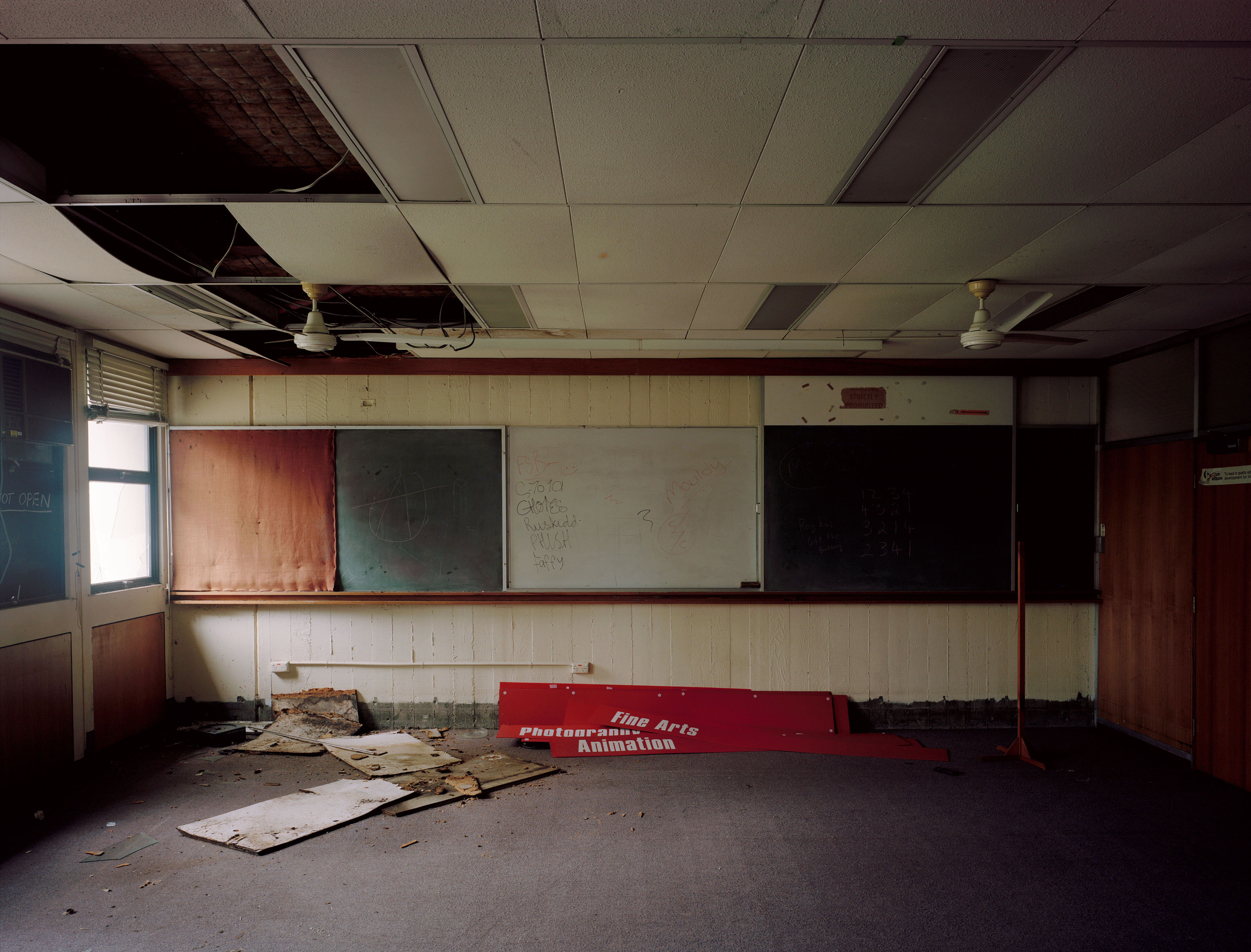
Cuthbert was studying at the Queensland College of Art (QCA) Seven Hills
campus, here in Meanjin / Brisbane, around the same time that The
Düsseldorf School’s star was rising internationally. Many of his generation
were taught in this groundbreaking style, and have held steadfast to it - for
good reason. Its capacity to exude authority is nearly unmatched. Its
sovereign, dispassionate gaze rivals the concrete veracity of social
documentary photography. Cuthbert leverages this powerful technique to
train our attention toward the marginal places of our lives and awareness.
The arresting detail and realism of his images court lengthy viewing often
not afforded to such places in real life. We linger empathetically in front of
his weary structures, witnessing their transmutation from architectural
detritus into moving portraits. They speak of loss and the relentless melt of
time. They are made in the spirit of 16th Century Momento Mori paintings -
helping us face the inevitability of change and endings.
Cuthbert has lived to see his college campus transform into a ruin, yet
although its material form has decayed, the energy and ideas seeded there
continue to flower into the present day. Seven Hills was just one of many
seasons at the QCA. The college finds its origins lying as far back as 1849,
on Queen Street - it’s the oldest arts institution in Australia. For better or for
worse, over time, we begin to trust that each iteration of the organism will mutate and adapt to meet the environmental conditions of the day. The
Seven Hills closure pathed the way for my generation to enjoy world class
facilities and art pedagogy. Many of the most efficacious educators
teaching my cohort were trained at Seven Hills. Cuthbert’s work is a visual
epitaph through which we may contemplate the significance and
impermanence of place in our lives. This exhibition also gives pause to
those of us who sense the shifting sands arriving again. How much longer
will the current South Bank campus hold, and what might its next material
evolution give way to?
Simon Cuthbert
Alma mater #5
2011/2012